NKRO vs Ghosting: Why an NKRO Keyboard Still Drops Keys
N-key rollover lets a keyboard report many simultaneous presses without phantom keys, but it does not guarantee every keystroke under every condition. HID report design, firmware, debounce, matrix scanning, connection behavior, and host input handling can still limit large chords. The guide separates ghosting from rollover failures, explains boot-protocol and descriptor limits, distinguishes rollover from polling rate, and shows how a browser keyboard tester can reveal the delivered event pattern while remaining unable to certify the hardware's internal matrix or diode design.
What the label says vs what actually happens
| You read on the box | What it actually means |
|---|---|
| “Full NKRO” | The firmware can report a very high number of simultaneous keys, not necessarily every key always. |
| “No ghosting” | Genuine diode isolation prevents phantom keys under the tested combinations, but firmware tricks may not cover all scenarios. |
| “Works with any game” | The board still has a HID descriptor ceiling and a scanning cycle — very large chords can still lose keys. |
| “N-key rollover” | N is set by the keyboard, not by the protocol. A board claiming 6KRO has a practical ceiling of six. |
The specifications are not lies, but they are not complete pictures. The label tells you what the board is designed to handle; the descriptor and firmware tell you what it can actually deliver under tested conditions.
“Full NKRO” ranks among the most heavily advertised keyboard specifications, typically presented as a guarantee that you will never miss a key. That framing is half accurate. A genuinely diode-isolated NKRO implementation completely solves matrix ghosting, but the “NKRO” label alone does not prove such an implementation, and even a true NKRO board does not guarantee that every keypress is captured under all conditions. The gap between those two statements produces considerable confusion, a steady stream of unnecessary returns, and a great deal of forum argument between people describing different problems using the same word.
Ghosting and rollover are two different problems
Ghosting: a matrix wiring problem
Ghosting is a hardware matrix artefact. Keyboards scan their keys as a grid of rows and columns rather than wiring each switch individually, because individual wiring would require an impractical number of controller pins. In a matrix without isolation diodes, pressing three specific keys can complete an electrical path that convinces the controller a fourth, untouched key is also down. That phantom registration is ghosting, and it is a property of the circuit design rather than the firmware.
Rollover: how many keys register at once
Rollover, abbreviated KRO, describes how many keys the board can report simultaneously. 2KRO means two at once, 6KRO means six, and full NKRO means, in principle, all of them.
How NKRO eliminates ghosting
NKRO is the fix for ghosting, because correct implementations place a diode in series with each switch so current cannot flow backward through unpressed keys and create false paths. A correctly designed and correctly implemented diode-isolated matrix prevents traditional matrix ghosting. If a board genuinely implements NKRO with diodes, phantom presses are effectively impossible under normal operating conditions. That part of the marketing claim is entirely accurate. Note that alternative matrix designs can also achieve high rollover without per-switch diodes; the key distinction is whether the electrical paths are isolated, not the specific topology.

The limit NKRO cannot remove
Here is what the marketing consistently omits. USB HID keyboards transmit keycodes inside report packets whose structure is declared in the device’s HID descriptor, and the maximum number of simultaneous keys a board can report is set by that descriptor and the firmware, not by a universal HID rule. The boot protocol permits six regular keys plus modifier bits. Beyond that, implementations differ: some use a larger report with a finite number of key slots, some use bitmap-style reports that can represent most or all keys, and some expose multiple logical HID interfaces. There is no single fixed ceiling across all keyboards — the practical limit is whatever a given board’s descriptor and firmware declare. Press a sufficiently large number of keys within a single report window and the packet simply has nowhere to put the surplus. NKRO firmware pushes this ceiling considerably higher than a basic 6KRO board, using techniques such as bitmap-style reports or presenting multiple logical HID interfaces, but no firmware can exceed the capacity its own descriptor declares to the host. The consequence is that even a board advertised as full NKRO can drop keys during extreme chords, not because of ghosting, which the diodes have eliminated, but because the report reached its descriptor-declared capacity. This is genuinely rare in normal use. It is nevertheless the reason that NKRO does not mean infinite keys with zero loss under any load.
Why your gaming board might still miss keys
When a high-rollover board drops keys in practice, the likely causes include:
- HID report overflow during unusually large simultaneous presses, as described above.
- Firmware or debounce lag when actuation occurs faster than the scanning cycle resolves cleanly — often the most common cause on budget boards.
- An overstated NKRO claim, where the specification sheet exceeds the implemented reality.
- Host-side or OS input handling — an overloaded USB controller, an inadequate hub, or heavy processor load can contribute, but for a typical desktop keyboard USB bandwidth is rarely the bottleneck. A dropped key is more often a firmware, debounce, or matrix-design issue than a bandwidth one. Distinguishing between them requires a tester that logs the raw event codes the browser actually received, because only then can you see precisely which keys arrived and which never did. Guessing from how the keyboard feels reliably produces the wrong diagnosis.
Rollover and polling rate are not the same thing
These two specifications are independent, and conflating them leads to buying the wrong upgrade:
- Rollover (KRO) determines how many keys can register concurrently.
- Polling rate (Hz) determines how frequently the board reports to the computer, typically 125, 250, 500, or 1000 times per second. A board can offer 1000Hz polling with only 2KRO, or full NKRO at a modest 125Hz. High polling can reduce waiting at the reporting stage, while high rollover lets more presses register together. If your complaint is perceived delay, investigate polling rate, frame time, and system latency. If your complaint is keys vanishing during chords, investigate rollover and the HID report design. Treating them as one specification can lead you toward an upgrade that does not address the symptom.
How much rollover do you genuinely need?
Match the specification to your actual usage rather than to the marketing tier:
- Prose typing: 6KRO is usually sufficient because ordinary typing involves relatively small overlapping combinations.
- Mainstream gaming: 6KRO often covers two movement directions plus modifiers and an ability binding, but test the combinations your game actually uses.
- Rhythm games, stenography, complex macro layouts: full NKRO can be valuable because these use cases deliberately use larger simultaneous inputs. If a retailer insists that full NKRO is essential regardless of use case, that is a sales position rather than a technical requirement.
Verify rather than trusting the label
Our keyboard tester displays a live key map alongside a log of the key-down and key-up events the browser received. Press a deliberately difficult chord and check three conditions: every key you pressed illuminates, no key you did not press illuminates, and every pressed key appears in the event log. Then increase the chord size progressively until something fails. This reveals how many simultaneous keys your OS and browser delivered to the page — a practical, browser-observed rollover limit. It cannot read the keyboard’s HID descriptor or prove the internal matrix is diode-isolated, so treat a clean result as strong evidence rather than a hardware-level certification.
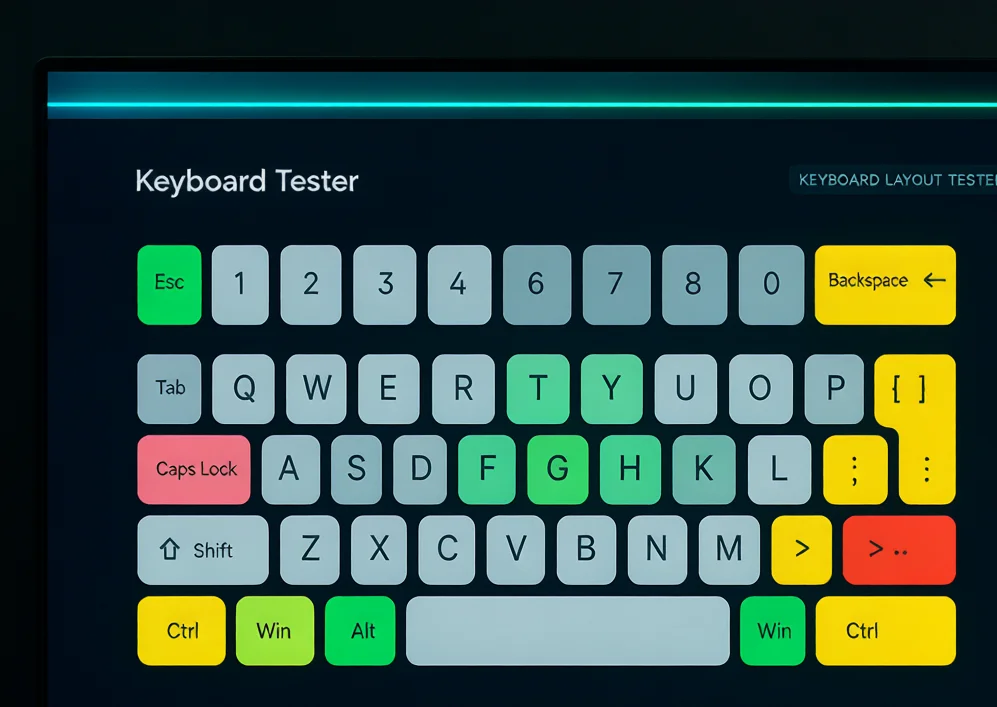 If keys drop only when connected through a hub, or only while the system is under heavy load, the keyboard is probably innocent and the fault lies in the connection path or host configuration. Test directly on a motherboard port before concluding anything about the hardware.
The matrix scanning cycle: how keyboards actually read keys
Understanding how a keyboard detects keypresses at the hardware level clarifies why ghosting occurs, why diodes prevent it, and why scan rate matters alongside rollover specifications. The process is more intricate than the simple “press a key, send a signal” model that most users imagine. Inside the keyboard, the switches are arranged in a grid of rows and columns. Each switch sits at the intersection of one row line and one column line. The microcontroller cannot read all keys simultaneously; instead, it scans them rapidly by driving one row line high at a time and reading all column lines to see which switches on that row are pressed. It then moves to the next row and repeats. A full scan of a typical matrix takes well under a millisecond on modern controllers — exact figures depend on the controller and firmware — so the scan rate is generally in the thousands of times per second. In a matrix without isolation diodes, pressing multiple keys on the same row or column can create unintended electrical paths. If three keys form an L-shape on the grid, current from the active row can flow through the pressed switches and back up an inactive row, making the controller believe a fourth key — one at the corner of the L — is also pressed. This is the ghosting mechanism, and it is a direct consequence of the matrix design. The scan is fast, but the electrical paths are not isolated. Adding a diode in series with each switch is a common way to block reverse current and prevent traditional ghost circuits. A product marketed as hardware-level diode NKRO normally uses per-switch isolation, but alternative matrix designs exist, and a board can report many simultaneous keys without proving that it uses that exact topology. The absence of visible per-key diodes therefore does not by itself determine the board’s delivered rollover or ghosting behavior. The scan rate also interacts with debounce. When a mechanical switch closes, the contacts physically bounce for a short period — commonly a few milliseconds, varying by switch design — producing rapid on-off transitions. The controller must wait for the bouncing to settle before registering the keypress, which means each scan cycle includes a debounce check. If the scan cycle is one millisecond and the debounce window is five milliseconds, the controller needs five consecutive scans showing the key pressed before it commits the event. This debounce delay is a deliberate trade-off: shorter windows respond faster but risk registering noise; longer windows are stable but add input latency. The debounce implementation is a firmware design decision, which is why two keyboards with identical switch hardware can feel different in responsiveness. If your game or application routinely holds many keys at once, NKRO with robust isolation may be a genuine benefit. For common gaming chords of three to five simultaneous keys, a well-designed 6KRO board may be enough, but the exact combinations matter. Before paying an NKRO premium, test the board you own or check a model-specific technical review. A clean browser result is useful evidence of delivered behavior, not a hardware certification.
Why diodes cost money: the manufacturing economics of NKRO
If diodes solve ghosting so effectively, why doesn’t every keyboard include them? The answer is economic, and understanding the cost structure helps you interpret manufacturer claims more critically. In a traditional diode-isolated NKRO matrix, each switch has an associated diode. The component itself is only one part of the cost: the PCB layout, assembly, soldering, inspection, and firmware all contribute. Exact costs vary by supplier, production volume, matrix design, and whether the keyboard uses a different architecture, so a simple per-key dollar estimate is not reliable. Many budget membrane keyboards use printed conductive traces on flexible sheets rather than discrete switch components. Adding per-key diodes to that construction would require a different or hybrid design and additional assembly, weakening part of its cost advantage. This does not mean every membrane architecture is identical or that high rollover is impossible; the implementation must be evaluated by model. Premium mechanical keyboards often advertise NKRO as a feature, while less expensive designs may use different matrix layouts, bitmap reports, or multiple logical interfaces to raise their delivered rollover. A report-format technique can increase the number of representable keys but does not by itself prove how the electrical matrix handles ghost-prone combinations. The label therefore does not fully describe the implementation, which is why model-specific testing remains useful. This economic structure also helps explain the persistence of 6KRO as a standard. Six-key rollover can be achieved on a diode-free matrix through careful layout that avoids common ghost-prone combinations. For manufacturers targeting mainstream gaming, 6KRO may deliver adequate functionality at lower assembly complexity, while full NKRO adds headroom for users who need it. The price difference varies too much by design and model to reduce to a universal retail premium. For the buyer, the practical takeaway is to treat NKRO claims as a starting point rather than a complete description. Test progressively larger chords and observe whether pressed keys disappear or phantom keys appear. The result tells you what reached that browser on that host and connection; it is more useful for your real combinations than the label alone, but it does not reveal the internal matrix design.
Should you buy NKRO?
True diode-isolated NKRO ends matrix ghosting under normal operating conditions, but the “NKRO” label does not by itself prove that implementation, and every board still has a practical simultaneous-press ceiling set by its HID descriptor and firmware. Interpret “full NKRO” as meaning no phantom keys and a high simultaneous-press capacity in practice, rather than literally every key, always, under any conceivable load. Test your specific board before trusting its label, distinguish rollover problems from polling problems since they require different remedies, and investigate firmware, debounce, and OS input handling before assuming a hub or bandwidth issue.